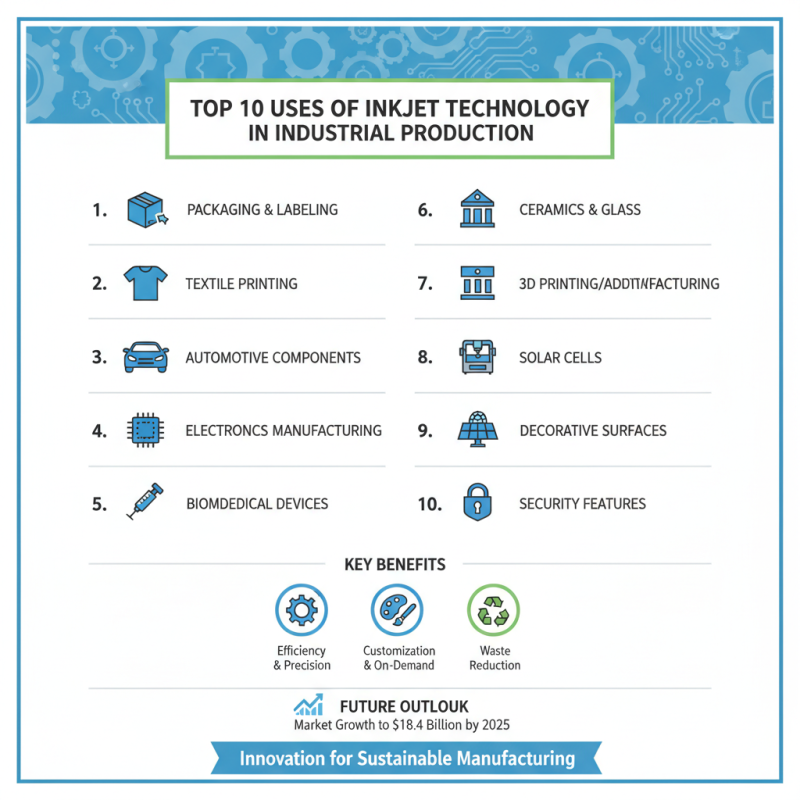
Inkjet technology has revolutionized industrial production, enhancing efficiency and precision. According to a report by Smithers Pira, the global inkjet printing market is projected to reach $18.4 billion by 2025. This significant growth underscores the increasing reliance on inkjet technology across various sectors, including packaging, textiles, and automotive industries.
Experts like Dr. Lisa Andrews emphasize its versatility, stating, "Inkjet technology is transforming manufacturing processes by enabling on-demand production and personalization." This technology allows for customization without the extensive setup costs associated with traditional printing methods.
However, challenges remain in terms of material compatibility and print durability. Companies must invest in research to optimize ink formulations and achieve desired outputs. Understanding how inkjet technology is used in industrial production is essential for innovation. The potential for sustainable development through waste reduction and energy efficiency warrants ongoing exploration. Embracing these advancements will foster new opportunities while addressing current limitations.
Inkjet technology has revolutionized industrial marking and coding, making it a vital component in production lines. According to industry reports, more than 30% of manufacturers have adopted inkjet solutions for their coding needs. This technology allows for high-speed printing with remarkable precision. Industries such as food and beverage, pharmaceuticals, and electronics primarily utilize this method.
In food packaging, inkjet printing provides accurate expiration dates and barcodes. This is crucial for ensuring product safety and compliance. Additionally, research shows that nearly 65% of consumers prioritize clear labeling when purchasing food products. Inkjet systems can integrate seamlessly into production lines, minimizing downtime and improving efficiency. Despite its advantages, companies sometimes face challenges in ink adhesion and print quality on various surfaces.
The pharmaceutical industry benefits significantly from inkjet technology, particularly in serialization. According to recent data, over 75% of pharmaceutical companies implemented inkjet for compliance with stringent regulations. Utilizing this technology helps maintain traceability and combats counterfeit drugs. However, frequent maintenance issues can affect output quality and consistency, highlighting the importance of regular system checks.
| Application | Industry | Description | Advantages |
|---|---|---|---|
| Product Marking | Manufacturing | Inkjet technology is used to print product information directly onto surfaces. | Fast, accurate, and allows for high-resolution prints. |
| Labeling | Retail | Labels are printed on demand for various products. | Reduces inventory of pre-printed labels and increases flexibility. |
| Packaging Printing | Food and Beverage | Direct printing on packaging materials. | Enhances shelf appeal with vibrant color options. |
| Barcode Printing | Logistics | Creates barcodes on products and shipping materials. | Improves accuracy in inventory management and tracking. |
| 3D Printing | Engineering | Used for additive manufacturing and prototype development. | Provides complex geometries and reduces material waste. |
| Textile Printing | Fashion | Direct-to-fabric printing for custom designs. | Allows for detailed designs and quick turnaround times. |
| Product Serialization | Pharmaceuticals | Uniquely codes each product for tracking and compliance. | Enhances product integrity and traceability. |
| Decorative Printing | Consumer Goods | Custom designs and finishes on various products. | Increases aesthetics and brand recognition. |
| Date and Lot Coding | Food Industry | Printing expiration dates and lot numbers on packaging. | Ensures compliance with safety regulations. |
| Industrial Signage | Construction | Printing directional and safety signage on-site. | Enhances worker safety and communication. |
: Inkjet technology allows for custom fabric designs by printing intricate patterns directly on textiles.
Unlike traditional techniques, inkjet printing requires less setup and enables short runs without high costs.
Designers can experiment with colors and motifs in real-time, minimizing waste by applying ink only where needed.
Some ink may fade or wash out over time, raising concerns about the longevity of printed fabrics.
Inkjet printing uses less water compared to traditional methods, but the inks’ environmental impact needs more research.
Inkjet technology provides customized printing solutions, essential for precise circuit board printing and increasing production speed.
Durability and ensuring electrical performance of printed components remain significant concerns.
It allows for precise material deposition, creating complex structures with better speed and accuracy than before.
Problems with ink viscosity, material compatibility, and adhesion can lead to failures or defects in prints.
Engineers and material scientists work together to address limitations, explore new possibilities, and improve processes.
Inkjet technology plays a pivotal role in industrial production across various sectors. One significant application is in marking and coding, where inkjet printers provide fast and precise labeling for products, ensuring clear identification and compliance with regulations. Additionally, inkjet printing is utilized for packaging and labeling solutions that enhance brand visibility and aesthetic appeal, while also allowing for customization and quick turnaround times.
Moreover, this technology is gaining traction in the textile industry, enabling vibrant and intricate custom fabric designs. In electronic component manufacturing, inkjet applications facilitate the production of intricate circuit patterns rapidly and efficiently. Lastly, advancements in 3D printing techniques leveraging inkjet technology showcase its versatility and potential for innovation. Overall, understanding how inkjet technology is used in industrial production reveals its transformative impact on efficiency and creativity within manufacturing processes.

 Magly Printer